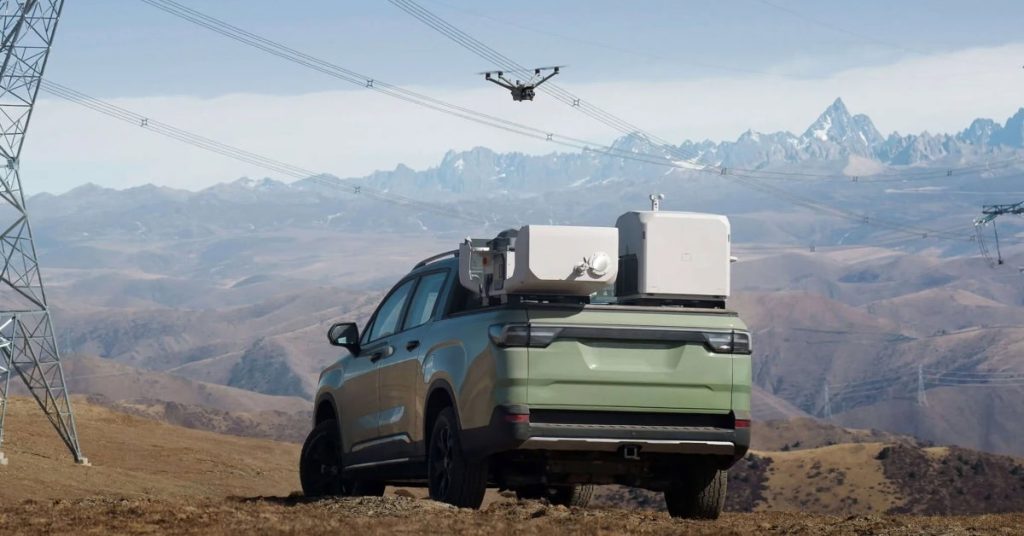

What if an enterprise drone could respond to an emergency, capture critical aerial information, and return to service in less than a minute without manual battery replacement? As industries increasingly depend on real-time aerial intelligence, traditional drone operations face limitations involving battery charging, deployment delays, and continuous monitoring. These challenges can affect response times, operational efficiency, and the ability to maintain consistent surveillance across large or remote areas.
Launched on October 14, 2026, the DJI Dock 4 introduces a new approach to autonomous drone operations with automated battery swapping, advanced aerial sensing, and intelligent mission management. Paired with the new DJI Matrice 5TD, the system combines rapid deployment, multisensor imaging, and AI-powered object detection to support public safety, infrastructure inspections, security, and emergency response.
The result is a drone docking solution designed to keep aerial intelligence available when every second matters.
Automated Battery Swapping for Continuous Drone Operations
One of the greatest limitations of automated drone deployments is the downtime required between missions. Conventional docking systems depend on battery recharging, which can interrupt monitoring operations and delay critical responses. For emergency services and infrastructure operators, maintaining aerial availability is essential when conditions change unexpectedly.
The DJI Dock 4 addresses this challenge with DJI’s first automated battery-swapping docking system. It completes a battery exchange in less than 25 seconds, with an operational turnaround time of under 45 seconds between landing and the next takeoff under controlled test conditions. The dock accommodates up to three stored batteries, enabling repeated missions with significantly reduced interruptions.
Combined with the Matrice 5TD’s maximum flight time of 59 minutes, this technology supports extended operational coverage while minimizing manual intervention.
Faster turnaround improves mission readiness, but reaching an incident quickly is equally important for time-sensitive operations.
DJI Dock 4 vs. Dock 3: What’s New and Why It Matters
The DJI Dock 3 established a strong foundation for automated drone operations, providing remote deployment, intelligent monitoring, and reliable aerial inspections. However, its reliance on battery recharging created downtime between missions, particularly during continuous monitoring and emergency response.
The DJI Dock 4 introduces a major improvement with fully automated battery swapping, reducing the operational turnaround from approximately 30 minutes to less than 45 seconds under controlled test conditions. Its expanded operating temperature range, enhanced communications, and integrated backup power capabilities further strengthen its performance in demanding environments.
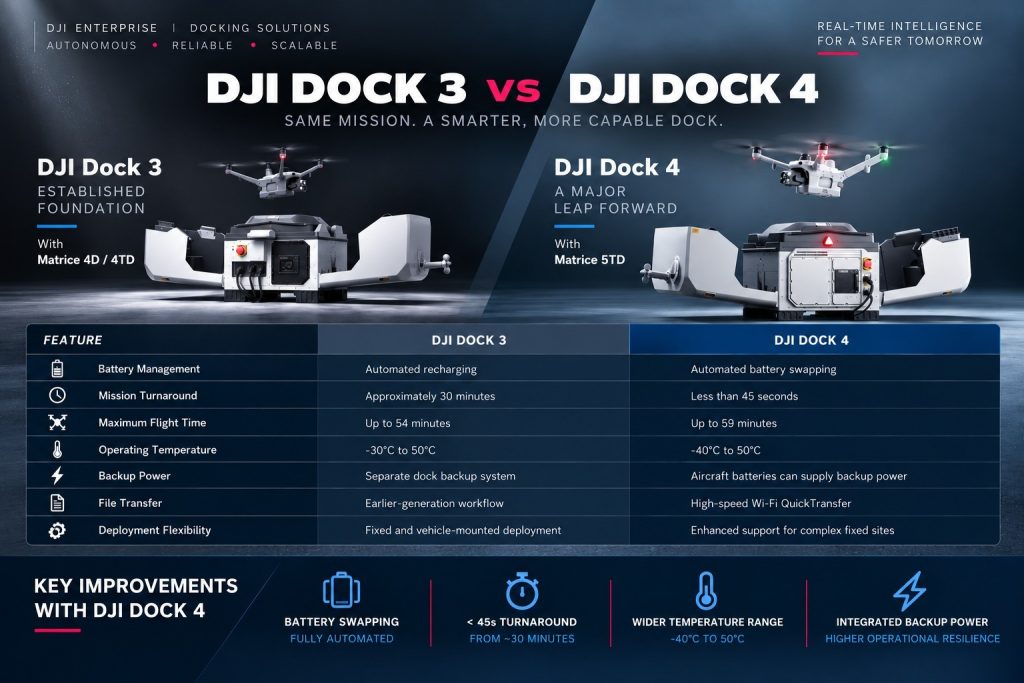
The most significant advancement is the dramatic reduction in time between flights. Instead of waiting for an aircraft to recharge, organizations can quickly return their drone to service, supporting time-sensitive inspections, emergency response, and recurring monitoring missions.
The DJI Dock 4 also expands operational flexibility through its O4 Ground Station and enhanced environmental resilience. These improvements make it particularly valuable for organizations that require frequent deployments, reliable communications, and fast access to aerial intelligence.
For existing DJI Dock 3 users, the decision to upgrade depends on mission frequency, response requirements, and deployment conditions. Organizations operating frequent or urgent missions may benefit considerably from the Dock 4’s faster turnaround, while teams with less demanding schedules may find their existing Dock 3 systems sufficient.
Rapid Drone Deployment for Emergency Response
Emergency response teams often need immediate aerial visibility before personnel reach an incident location. Whether assessing a fire, investigating a security alert, or coordinating search-and-rescue operations, early situational awareness helps responders understand conditions and allocate resources more effectively.
The DJI Dock 4 supports rapid remote deployment, allowing the Matrice 5TD to launch automatically when commanded. During supported FlyTo missions, the aircraft reaches speeds of up to 21 m/s, helping it travel quickly toward an incident. Its dedicated transmission architecture enables drone-to-cloud video latency as low as 160 milliseconds, supporting responsive live monitoring.
Through integration with DJI FlightHub 2, authorized operators can remotely access aerial footage, manage missions, and coordinate responses from a centralized platform.
Rapid deployment provides immediate visibility, while advanced imaging systems help ensure that the information collected is useful for operational decisions.
Advanced Multisensor Imaging with the DJI Matrice 5TD
Enterprise missions frequently involve challenging environments, variable lighting, and objects that cannot be safely approached from the ground. Public safety agencies, inspection teams, and security operators need versatile imaging technology capable of documenting conditions accurately across different scenarios.
The DJI Matrice 5TD integrates wide-angle, medium telephoto, and telephoto cameras with infrared thermal imaging and laser rangefinding. Its three visible-light cameras feature 50 MP sensors, while its thermal system supports infrared imaging up to 2560 × 2048 resolution in UHR mode.
The aircraft also includes enhanced nighttime imaging and visible-thermal fusion capabilities, helping operators identify temperature differences and examine structural features under challenging lighting conditions.
These capabilities allow teams to conduct visual inspections, detect potential overheating, observe emergency scenes, and investigate distant objects without requiring separate aircraft for every task.
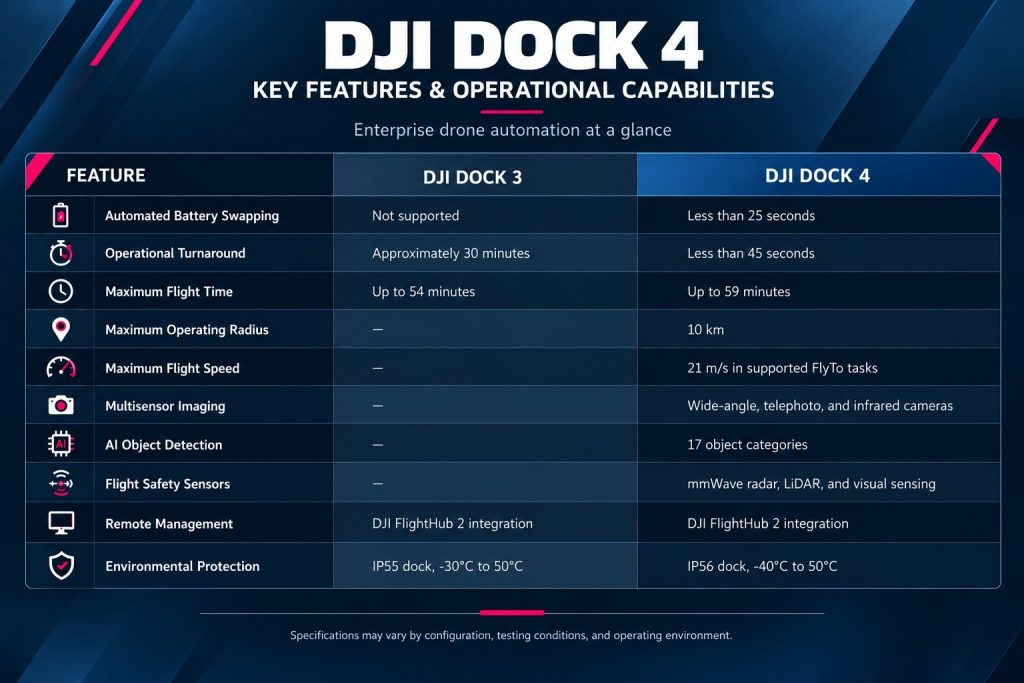
Specifications reflect DJI’s published test conditions. Actual performance depends on configuration, environmental conditions, and operational requirements.
AI-Powered Detection and Intelligent Mission Management
Managing large-scale drone operations requires more than capturing aerial imagery. Operators must identify relevant information, monitor changing conditions, and respond efficiently without manually reviewing every moment of recorded footage.
The DJI Dock 4 ecosystem introduces enhanced AI-powered workflows through the Matrice 5TD and DJI FlightHub 2. The aircraft supports real-time recognition of 17 object categories, including vehicles, boats, and animals. Operators can use intelligent search and monitoring functions to identify relevant objects and receive notifications when configured detection conditions are met.
Automated alerts and predefined mission actions can assist with tracking, recording, and documenting events, reducing the burden of continuous manual observation.
By combining AI detection with centralized mission management, organizations can improve monitoring efficiency while maintaining human oversight of operational decisions.
Reliable Drone Operations in Challenging Environments
Automated docking systems must perform consistently despite changing weather, difficult terrain, and obstacles around deployment sites. Infrastructure facilities, industrial compounds, and remote installations can present additional challenges involving communication reliability and flight safety.
The DJI Dock 4 features an IP56-rated enclosure and an operating temperature range from -40°C to 50°C. Integrated environmental monitoring and battery temperature management help support operations across demanding conditions.
The Matrice 5TD combines mmWave radar, LiDAR, and visual sensing to enhance obstacle detection. When used with the DJI O4 Ground Station, the system can also improve communication coverage in environments where buildings or infrastructure obstruct direct transmission paths.
Although these technologies strengthen operational reliability, safe deployment still requires appropriate site assessments, weather evaluation, regulatory compliance, and mission supervision.
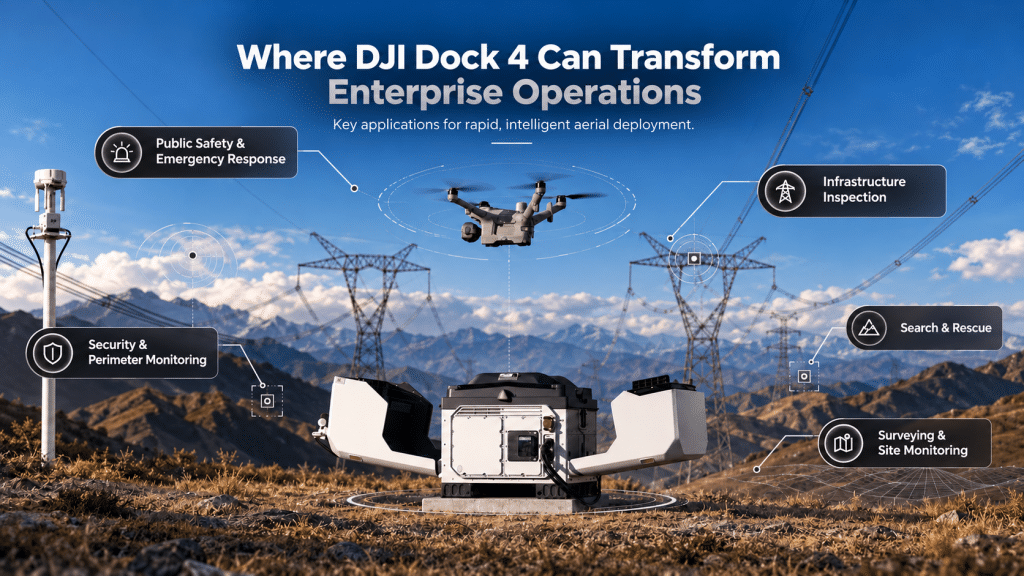
Where DJI Dock 4 Can Transform Enterprise Operations
The combination of rapid deployment, thermal imaging, AI detection, and automated battery management makes the DJI Dock 4 relevant across several professional applications.
Public safety and emergency response: Rapid aerial deployment helps responders assess incidents, monitor hazards, and establish situational awareness before ground teams arrive.
Infrastructure inspection: Repeated aerial missions support visual and thermal assessments of power infrastructure, industrial facilities, and other critical assets.
Security and perimeter monitoring: Scheduled patrols and AI-assisted detection help security personnel investigate unusual activity across large properties.
Search and rescue: Thermal imaging, zoom cameras, and live video provide additional aerial information when locating missing individuals or examining difficult terrain.
Surveying and site monitoring: Repeatable missions can document site conditions, track visible changes, and support ongoing project assessments.
Across these applications, the primary advantage is consistent access to aerial information with fewer interruptions between deployments.
Why DJI Dock 4 Represents a Major Advancement in Drone Automation
The DJI Dock 4 represents an important development in enterprise drone technology because it addresses several operational limitations within one integrated system.
Its automated battery-swapping mechanism reduces turnaround delays, while the Matrice 5TD provides advanced imaging and sensing for diverse professional missions. DJI FlightHub 2 adds centralized management and intelligent monitoring capabilities, helping organizations coordinate operations across multiple locations.
For businesses and agencies evaluating autonomous drone systems, these improvements create opportunities to increase mission frequency, strengthen situational awareness, and reduce routine manual deployment requirements.
Ultimately, the value of DJI Dock 4 extends beyond automation. It enables organizations to develop more responsive and dependable aerial monitoring workflows.
Discover the Future of Automated Drone Operations with DJI Dock 4
As enterprise drone applications continue to expand, organizations need solutions that deliver reliable aerial information without unnecessary delays. The DJI Dock 4 combines rapid battery swapping, advanced multisensor imaging, AI-assisted detection, and remote mission management to support demanding professional operations.
Whether your organization manages critical infrastructure, coordinates emergency response, or requires automated security monitoring, the DJI Dock 4 offers a powerful foundation for more efficient aerial operations.
Ready to explore how DJI Dock 4 could support your organization? Visit Dynatech Innovations to discover professional drone solutions and connect with its experienced team. Dynatech Innovations can help you evaluate your operational requirements, explore suitable DJI Enterprise technology, and identify an integrated drone solution aligned with your mission objectives.