

Getting critical cargo to a remote worksite, a disaster zone, or an offshore facility has always come with the same trade-off. Helicopters can cover distance but cost a fortune to operate. Multirotor drones are affordable and easy to deploy but their range and payload drop off quickly once you need to travel more than a few kilometers. For operators working across the Middle East and Africa, where job sites can sit hours from the nearest paved road, that gap has been a persistent operational headache.
DJI’s answer is the EV50, the company’s first electric vertical takeoff and landing (eVTOL) cargo drone. It is built to close the distance between short-hop multirotor deliveries and full-scale manned aircraft, giving logistics, energy, and emergency response teams a runway-free way to move real payloads over real distances.
What Makes the DJI EV50 Different
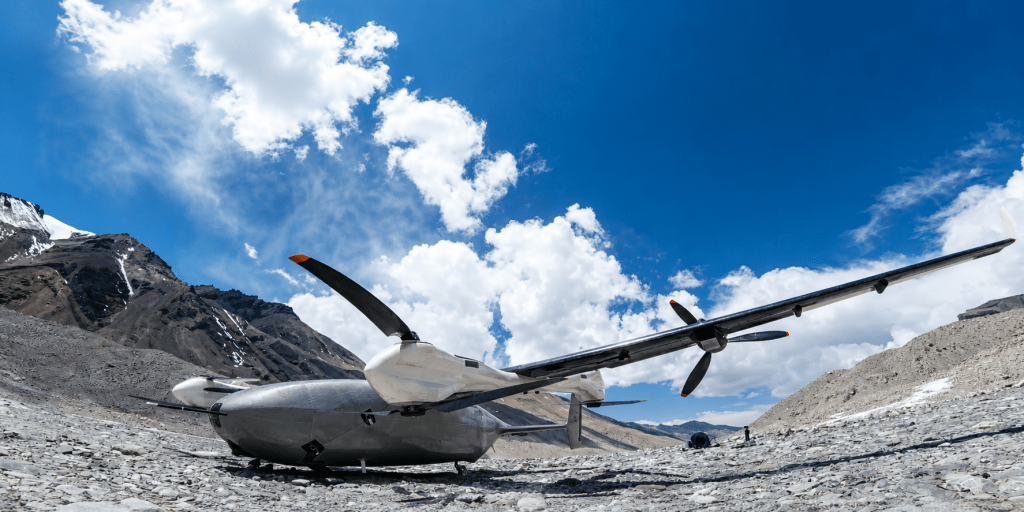
Most enterprise drones fall into one of two categories. Multirotor platforms like the FlyCart series lift heavy loads but burn power fast since their rotors generate lift for the entire flight. Fixed-wing aircraft cover distance efficiently but need a runway or catapult to launch, ruling out most remote or congested sites.
The EV50 is a compound-wing aircraft that combines both. Eight lift rotors get it off the ground, so it can launch from open ground, a rooftop, or a vessel deck without a runway. Once airborne, three rear propellers push the aircraft forward while its wings take over the job of generating lift, the way a conventional plane flies. The lift rotors then tuck into a low-drag position so they stop working against the aircraft’s efficiency.
This hybrid design lets the EV50 reach places a runway-dependent aircraft cannot while covering distances a standard quadcopter never could.
Key takeaway: The EV50 launches and lands like a multirotor drone, then cruises like a fixed-wing aircraft, giving it the reach of long-range logistics without needing a runway.
Proven at the Top of the World
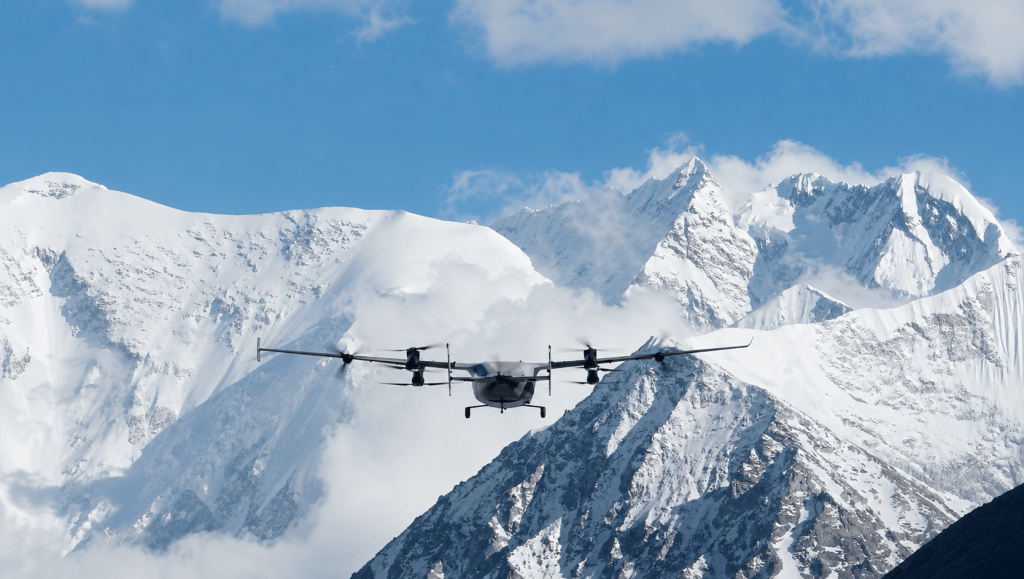
DJI introduced the EV50 through one of the most demanding field tests a cargo drone has completed. Working with researchers from Peking University’s College of Environmental Sciences and Engineering, the EV50 flew in the Qomolangma National Nature Reserve on the north side of Mount Everest, carrying ozone measuring equipment into the upper troposphere.
Over a twelve day expedition, the aircraft completed thirty two takeoffs and landings, including twelve research flights through some of the harshest wind and altitude conditions on the planet. Its highest flight reached 8,861 meters, above the summit elevation of Everest itself, with a continuous climb of 3,730 meters in a single sortie. The all-electric powertrain mattered beyond emissions too. Engine exhaust and rotor downwash can throw off delicate air-quality readings, so a clean, electric platform was a practical requirement for the mission, not just an environmental bonus.
That is not a marketing demo. It is a working aircraft proving it can operate reliably in thin air, freezing temperatures, and unpredictable mountain winds, the same variables that make cargo delivery difficult in remote, high-altitude, or desert environments.
Built for Payload, Range, and Redundancy
Underneath the headline-grabbing altitude record, the EV50 is engineered as a serious logistics platform.
- Payload capacity of up to 50 kilograms, with a 270-liter cargo compartment sized for standardized cargo modules
- Maximum unloaded range of 150 kilometers and a top cruising speed of around 160 kilometers per hour
- Eleven motors total, eight lift rotors and three pusher propellers, engineered to tolerate individual motor failures
- Heated backup airspeed sensors to prevent icing at altitude, plus two separate cooling systems and four independent batteries
- A standard emergency parachute for added safety
- A collapsible airframe a two-person crew can pack down in about five minutes, no tools required
- An open payload SDK ecosystem for adapting the platform to different missions
Together, these specifications point toward one thing: DJI engineered the EV50 with beyond visual line of sight operations in mind, where redundancy and fail-safes matter as much as raw performance.
Key takeaway: With a 50 kilogram payload, 150 kilometer range, and built-in redundancy across motors, sensors, and power, the EV50 is designed to operate safely well beyond the pilot’s line of sight.

Where the EV50 Fits in Real Operations
The combination of runway-free launch, long range, and a meaningful payload opens up use cases that neither multirotor drones nor traditional aircraft handle well on their own.
Emergency and disaster response. When roads are damaged or impassable, the EV50 can move medical supplies and emergency provisions into affected areas without waiting for ground access to be restored.
Remote and industrial logistics. Oil and gas facilities, mining sites, and offshore platforms often sit far from established infrastructure. Launching from a compound and cruising 150 kilometers to a remote site removes a major bottleneck in resupply.
Scientific and environmental research. As shown on Everest, the EV50 can carry sensitive instrumentation into environments too dangerous or difficult for research teams to reach on foot.
Island and cross-regional transport. For coastal and archipelago operations, the EV50 can move cargo across water or difficult terrain without depending on ferries or aircraft that require an airstrip.
Across these use cases, the value is the same: moving real cargo over real distances without the runway requirement of a fixed-wing aircraft or the cost of a helicopter. It is not a replacement for every drone in a fleet, but a new category built for the missions that fall between short-range multirotor drones and the cost of manned aircraft.
What to Look Forward to in the Middle East
DJI has not yet confirmed international availability for the EV50, with preorders currently open only in mainland China. Still, the platform’s design points directly at problems operators across the Middle East already face, which makes it one to watch as it moves toward wider release.
Geography is part of the story. Long stretches of desert separate oil fields, solar farms, and remote construction sites from population centers. Offshore platforms in the Gulf sit beyond the practical range of most delivery drones, and mountainous or coastal terrain can make road access slow or seasonal. An aircraft that launches without a runway and covers up to 150 kilometers on a charge fits these conditions well.
A few groups stand to benefit most once the EV50 reaches this market:
Energy and utility operators, moving spare parts, tools, and sampling equipment between sites spread across large, hard-to-reach areas.
Public safety and emergency response teams, carrying meaningful payloads into areas cut off by flooding, terrain, or damaged roads.
Construction and mining companies, getting on-demand delivery of parts and materials to project sites far from suppliers.
Maritime and offshore operators, moving supplies or replacement parts to vessels and platforms across the Gulf without waiting on boat transport.
Government and research institutions, running environmental monitoring, coastal surveys, and scientific fieldwork with the same long-range, sensor-carrying capability DJI demonstrated on Everest.
For any of these teams, the appeal is less about the drone itself and more about what it removes, the wait for a helicopter slot, the cost of a support convoy, or the risk of sending a crew into difficult terrain just to deliver a part.
Looking Ahead
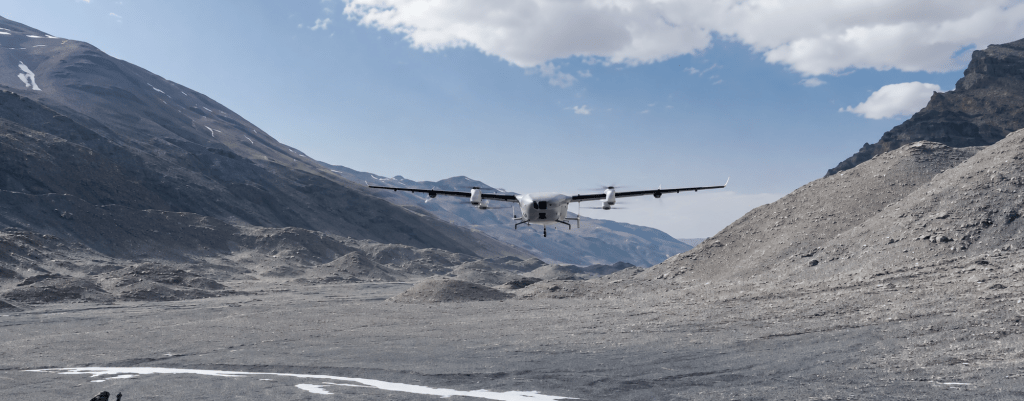
The EV50 marks DJI’s entry into large-scale eVTOL cargo logistics, extending a portfolio that has centered on camera and mapping drones into commercial aircraft territory. As the platform moves from testing to operational deployment, it points toward a future where long-range, runway-free cargo transport becomes a standard tool for emergency response teams, industrial operators, and research organizations alike.
Dynatech Innovations will continue monitoring the EV50’s rollout as DJI expands the platform beyond its initial testing phase. As a trusted DJI enterprise partner across the Middle East and Africa, we help organizations evaluate which drone platform fits their operational needs, from surveying and inspection to the next generation of aerial logistics.
Want to know how eVTOL cargo drones like the EV50 could fit into your operations? Reach out to the Dynatech Innovations team at [email protected] or +971 56 654 1303, or explore our full range of DJI enterprise drone solutions at dynatech.ae.
#DynatechInnovations #DynatechAE