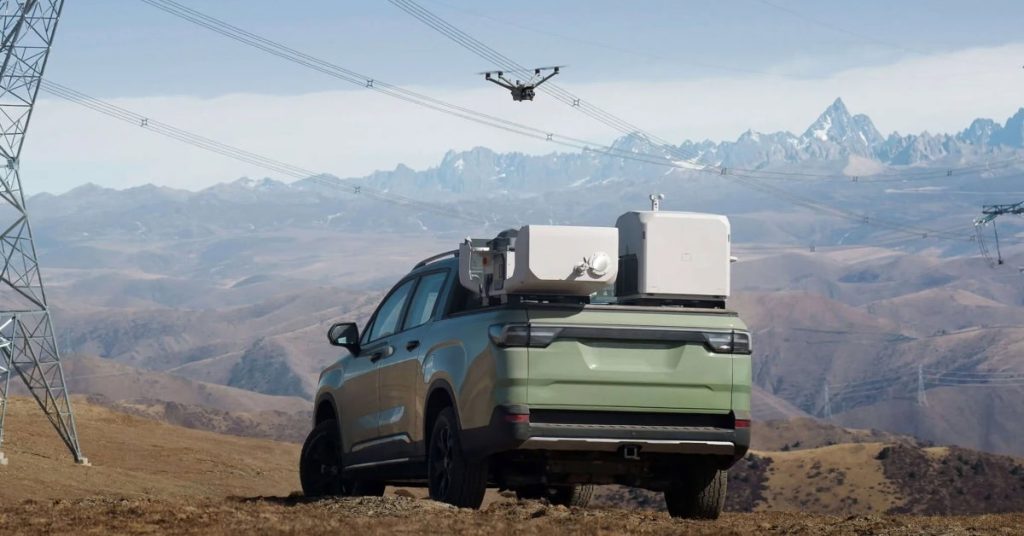

Your infrastructure team spots a critical defect Tuesday afternoon, but your drone operator doesn’t return until Thursday. By then, the damage has worsened, and response costs have doubled. This gap exists because traditional drone operations require constant human presence, and humans have limits.
DJI Dock 3 changes everything. For the first time, a dock solution supports mobile vehicle-mounted deployment, paired with Matrice 4D or Matrice 4TD drones and intelligent FlightHub 2 automation. DJI Dock 3 removes the operator from the equation, enabling genuinely continuous operations.
This isn’t an incremental upgrade. This is a fundamental reset of what round-the-clock drone programs can accomplish. Your team can now monitor infrastructure 24/7, respond to emergencies within minutes, and generate consistent data from remote locations with minimal human intervention.
In this article, we’ll explore what makes DJI Dock 3 transformative and how it’s redefining autonomous drone operations for enterprise organizations.
Autonomous Port Surveillance with DJI Dock 3 & Matrice 4TD
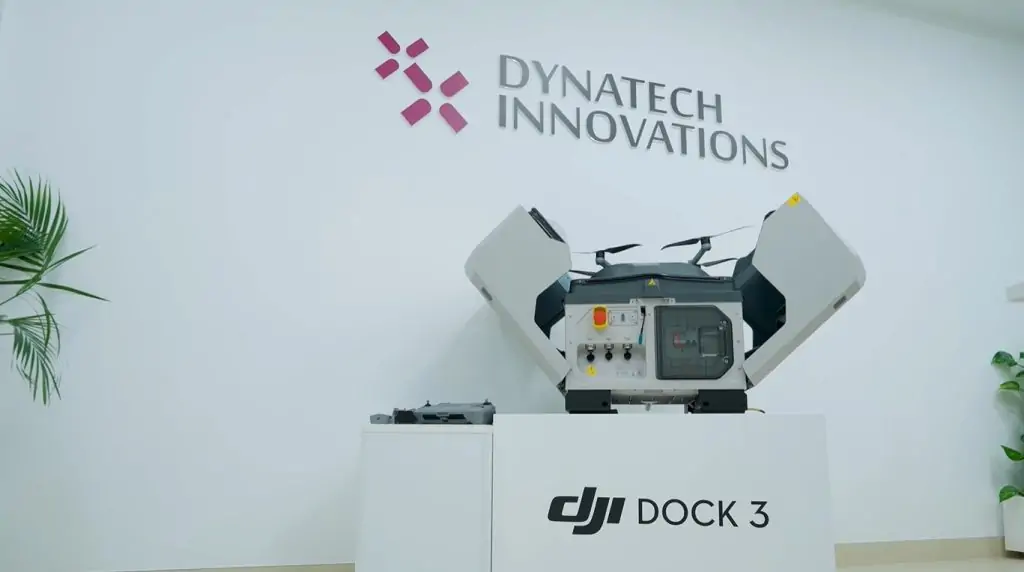
Why Continuous Operations Matter
Utility companies monitoring power lines catch equipment failures before outages cascade. Construction sites running 24/7 surveillance prevent unauthorized access and track progress automatically. Emergency response teams position DJI Dock 3 at disaster zones to gather real-time intelligence around the clock.
Continuous monitoring catches problems early, reducing expensive emergency responses. You eliminate labor costs from multiple operator shifts. DJI Dock 3 handles the entire cycle autonomously, freeing your team from repetitive launch and retrieval work.
Traditional fixed docks serve only one area, creating infrastructure gaps. DJI Dock 3’s mobile vehicle-mounted deployment changes this. Mount it on a truck and move with operational needs. Your utility company covers transmission corridors as needed. Your emergency team deploys surveillance to new zones within hours. Your construction operation positions monitoring is wherever work happens.
This flexibility eliminates expensive permanent dock facilities at multiple locations. One mobile platform serves your entire operational footprint. The real ROI isn’t the equipment cost. It’s the operational capacity that continuous deployment unlocks and the labor costs you eliminate.
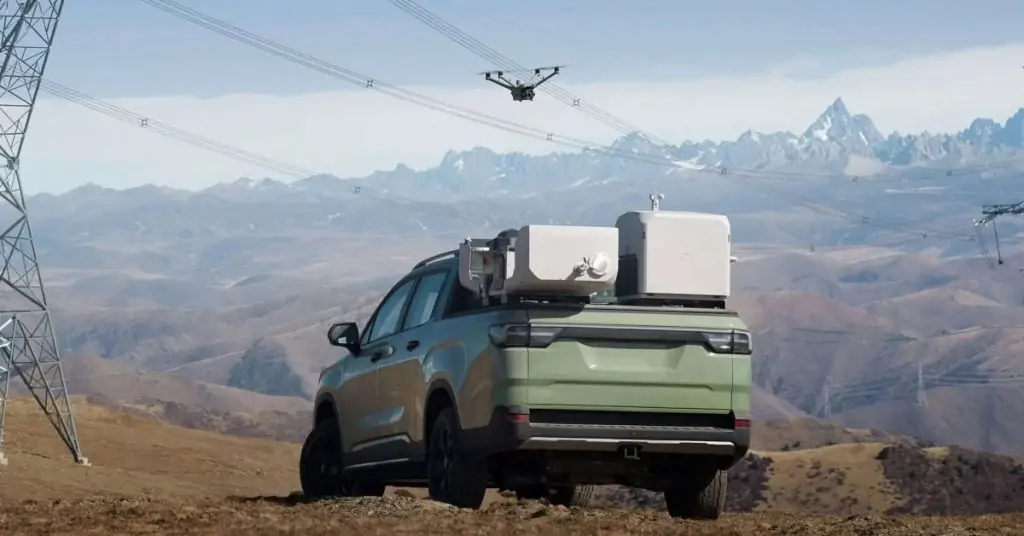
High-Performance Hardware That Runs Unattended
DJI Dock 3 pairs with Matrice 4D or Matrice 4TD drones, purpose-built for continuous operations without human oversight. When your system runs 24/7 autonomously, reliability becomes non-negotiable. These drones handle challenging conditions through enhanced durability, redundancy systems, and superior flight performance, managing wind, weather shifts, and battery degradation.
Camera quality directly impacts mission value. Improved sensors capture higher-fidelity imagery for better defect detection, clearer surveillance, and more accurate geospatial data. When the DJI Dock 3 continuously generates data, every flight contributes to operational intelligence. Poor image quality compounds across thousands of missions.
These drones prioritize consistent performance over marginal endurance gains. For 24/7 operations, reliability matters far more than extended flight time. This dependable foundation enables intelligent automation.
DJI Dock 3 Specifications
| Category | Specification |
| Compatible Drones | Matrice 4D, Matrice 4TD |
| Deployment Type | Stationary + Mobile Vehicle-Mounted |
| Operating Temperature | -20°C to 55°C |
| Environmental Protection | IP45 rated (dust and water resistant) |
| Automatic Charging | Yes, with battery management system |
| Mission Cycles Per Charge | Up to 6+ flights per battery cycle |
| Remote Operation | FlightHub 2 integration (24/7 capability) |
| Transmission Range | Ultra-long range via network connectivity |
| Data Security | Enterprise-grade encryption and compliance |
| Footprint | Compact design, mobile-ready |
| Weather Resilience | Operates in rain, wind, and temperature extremes |
| Maintenance | Automated diagnostics and alerts |
Where Hardware Becomes a Smart System
A dock without orchestration is just hardware. FlightHub 2 transforms DJI Dock 3 into an intelligent autonomous system, making continuous operations practical.
The foundation lies in pre-programmed missions. Once your team defines parameters, the Dock 3 executes them thousands of times with a precision no human pilot can replicate. Whether it is infrastructure patrols, security monitoring, or surveys, every flight follows the exact design, effectively eliminating human error.
FlightHub 2 uses AI to manage the complexities of autonomy. It monitors weather in real-time, adjusting flight plans and optimizing battery rotation across your fleet to ensure the right drone launches at the right moment.
Crucially, this shifts your team from active pilots to strategic supervisors. Operators maintain oversight via dashboards rather than micromanaging flight details. The results are clear: dramatic labor cost reductions, faster planning, and superior data consistency. This is where DJI Dock 3 delivers tangible, scalable ROI.
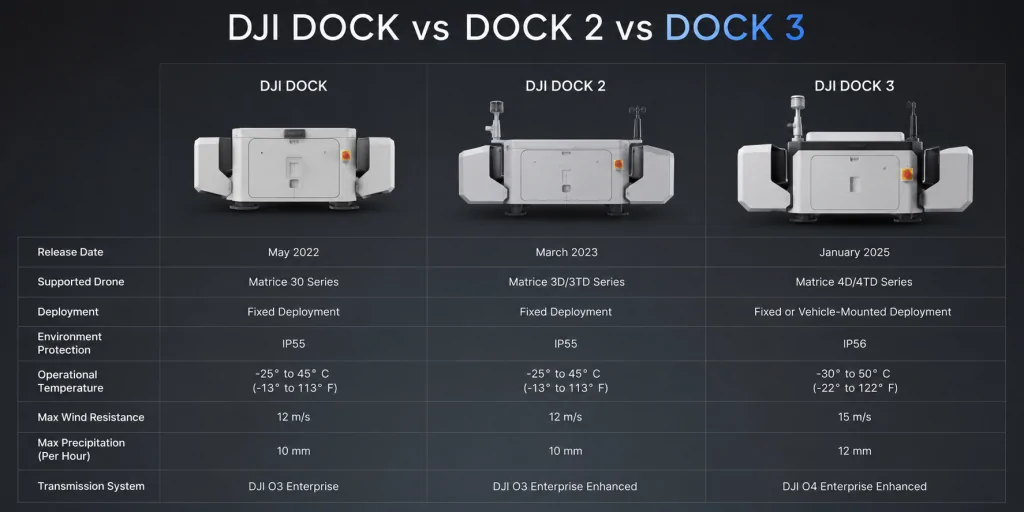
DJI Dock 3 vs Previous Generations
Autonomous Doesn’t Mean Uncontrolled
For many enterprise organizations, the question is not whether autonomous drone operations are possible, but whether they can be trusted. DJI Dock 3 addresses this concern with security, oversight, and safety mechanisms designed for professional environments.
Operational data is protected through enterprise-grade encryption across DJI Dock 3 and FlightHub 2, helping safeguard sensitive information during mission planning, flight operations, and data transfer. This is particularly important for infrastructure operators, public safety agencies, and organizations managing critical assets.
At the same time, autonomy does not come at the expense of visibility. Operators can monitor missions, review flight records, manage user permissions, and maintain clear operational oversight through centralized management tools.
Built-in failsafe features further enhance reliability. Automatic return-to-home actions, battery-based safeguards, and continuous system monitoring help ensure missions remain safe even when unexpected issues arise.
Rather than replacing existing workflows, DJI Dock 3 can integrate into broader operational ecosystems, allowing organizations to maintain control while benefiting from autonomous capabilities. The result is a system that delivers both efficiency and confidence in day-to-day operations.
Where Theory Becomes Operation
Different industries face different challenges, but DJI Dock 3 solves a universal problem: the gap between what needs monitoring and what human availability allows. Whether it’s utility companies catching equipment failure before outages, emergency responders gathering intelligence at disaster zones without risking personnel, or construction teams automating 24/7 site documentation, the pattern is consistent. Continuous operations eliminate human availability constraints. Teams accomplish more with fewer personnel. Decision-making accelerates. Costs decline while safety and data quality improve. Autonomous drone technology stops being aspirational and becomes competitive necessity.
How DJI Dock 3 Transforms Operations Across Industries
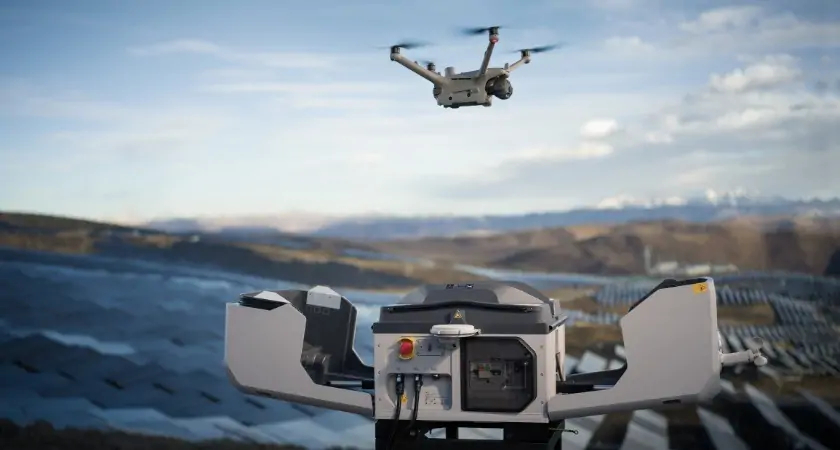
Here’s where DJI Dock 3 creates measurable impact. From utilities to emergency response, each industry discovers similar advantages: continuous monitoring, faster response times, and reduced operational costs.
| Industry/Field | Primary Application | Key Benefit | Operational Impact |
| Utilities & Power | Power line and substation inspection | Early fault detection reduces outage risk | Continuous monitoring with response time reduced from weeks to hours |
| Public Safety | Disaster response and emergency situational awareness | Safe deployment without exposing personnel to risk | Real-time aerial intelligence during active incidents |
| Infrastructure | Bridge, road, and facility inspection | Repeatable and standardized inspection data | Significant reduction in field visits and manual inspection cycles |
| Construction | Site progress tracking and documentation | Automated, scheduled site monitoring | Lower supervision overhead and faster project reporting |
| Geospatial & Surveying | Mapping, cadastral surveys, and land assessment | High-frequency data capture at scale | Faster delivery of survey outputs with improved data consistency |
| Oil & Gas | Pipeline and facility inspection | Continuous monitoring of remote assets | Reduced travel requirements and improved operational safety |
| Renewables | Wind and solar asset inspection | Performance monitoring over time | Improved maintenance planning and reduced downtime |
| Security & Surveillance | Perimeter monitoring and access control | Persistent aerial presence without fatigue | Consistent coverage and improved incident documentation |
The Future of Drone Operations Is Here
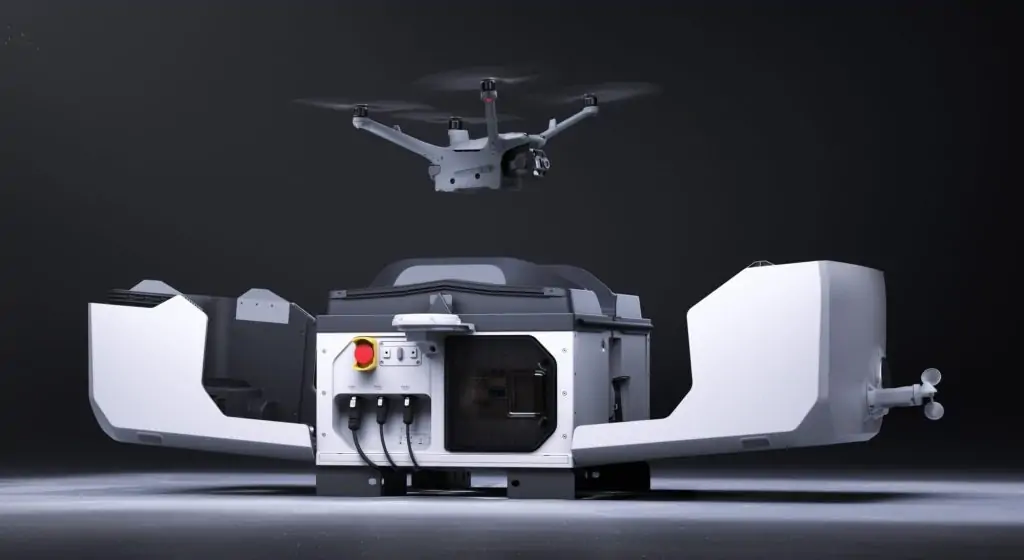
DJI Dock 3 is more than an upgrade to automated drone operations. By combining autonomous deployment, vehicle-mounted flexibility, remote mission management, and reliable all-weather performance, it enables organizations to operate drones with greater consistency and efficiency.
What makes the platform particularly valuable is how these capabilities work together. Teams can deploy drones where they are needed, automate recurring missions, and collect aerial data without requiring personnel on site for every flight. The result is faster response times, improved operational coverage, and more reliable access to critical information.
As industries increasingly rely on real-time aerial intelligence, solutions like DJI Dock 3 are helping make continuous drone operations a practical reality rather than a future goal.
If you’re ready to explore how DJI Dock 3 with Matrice 4D can support your operations, learn more about the solution and its capabilities at Dynatech’s product page. Whether your focus is infrastructure inspection, public safety, construction, or security, the platform is designed to support reliable 24/7 drone operations.