

Every offshore energy structure has a hidden side, and it lives underwater.
Beneath the waterline of every offshore wind turbine, oil platform, and subsea pipeline lies a world that most inspection teams struggle to access safely, affordably, and accurately. The structures holding up billion-dollar energy assets face constant exposure to saltwater corrosion, powerful currents, biofouling, and mechanical stress, yet the industry has long relied on the same two options to check their condition: send a diver down or deploy a large, expensive remotely operated vehicle.
That is starting to change. AI-driven underwater robotics has matured to a point where compact, intelligent systems can now do what once required entire dive teams or vessel-class ROVs. The FIFISH E-Master from QYSEA is a purpose-built industrial AI underwater robot designed for high-precision inspections, measurements, and subsea surveys in demanding marine environments, and it is already being deployed across offshore energy sectors worldwide.
Inside the FIFISH E-MASTER Navi: The Ultimate Underwater ROV for Inspection & Surveying
The Real Costs of Conventional Subsea Inspection Methods
Before understanding what makes the FIFISH E-Master valuable, it helps to look honestly at what the industry has been working around for decades.
Deploying engineering divers requires vessel support, safety standby teams, and significant logistical coordination. Large work-class ROVs demand even heavier infrastructure and trained operators. For routine or repeated inspections, these costs accumulate quickly and strain maintenance budgets that are already under pressure.
Safety is an equally serious concern. Strong tidal currents, low visibility, and deep-water pressure create genuine hazards for any diver operating near structural components. Even with proper protocols, human presence underwater introduces risk that cannot be fully engineered away.
Depth and time constraints add another layer of difficulty. Divers face hard physiological limits on how deep they can go and how long they can stay, capping the volume of work that can be completed in a single shift. On large offshore structures, this means inspections either take longer than planned or leave gaps in coverage.
Finally, manual underwater assessments are vulnerable to environmental interference. Murky water, current-induced movement, and limited lighting all degrade visual data and introduce human error into structural evaluations that demand precision.
Meet the FIFISH E-Master: An AI ROV Built for Industrial Precision
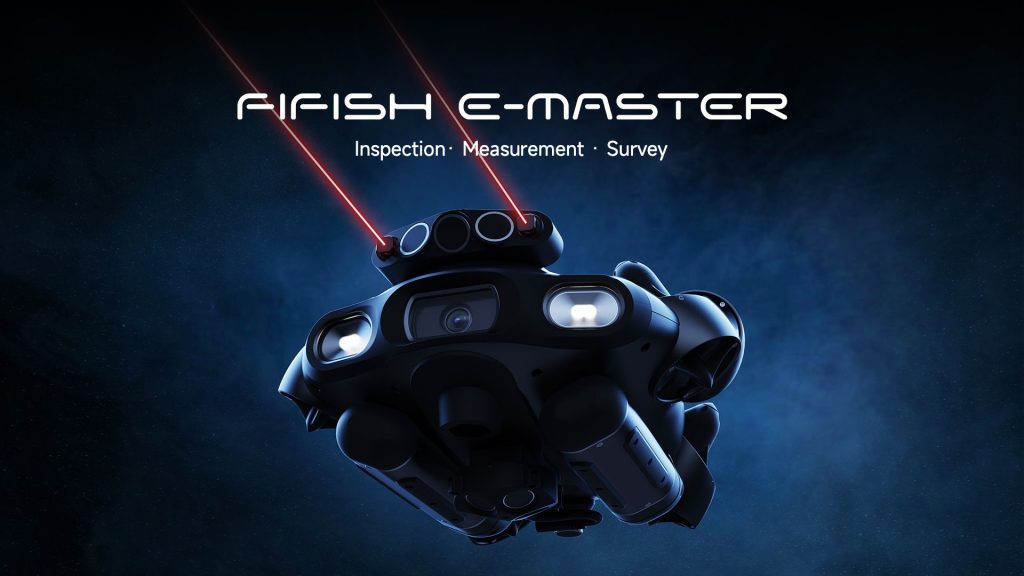
Given the limitations that have long defined conventional inspection work, the FIFISH E-Master arrives as a genuinely different kind of tool rather than just a smaller version of what already exists.
At its core, it is an industrial-class AI underwater robot developed by QYSEA for high-precision inspections, measurements, and subsea surveys in complex marine environments. What separates it from lighter professional ROVs is the combination of purpose-built hardware and intelligent software working together as a single system.
Propulsion is handled by a six-thruster ring-wing motor system that reaches speeds of up to 3 knots and holds its ground against currents of equal strength, a direct requirement for working near offshore structures where tidal forces are a constant variable.
The E-Master carries a 4K UHD camera with a 176-degree surface field of view, a 10 cm macro focus range for close-up structural detail, and a 10,000-lumen LED array. In the dark, sediment-heavy water common around offshore assets, that imaging and lighting combination makes a measurable difference in what operators can see and record.
The modular architecture keeps the system practical for extended field deployments, with full spare part replacement achievable in under five minutes.
FIFISH E-Master: Quick Specs at a Glance
| Thrusters | 6-thruster ring-wing motor system |
| Max Speed | 3 knots |
| Current Resistance | Up to 3 knots |
| Camera | 4K UHD, 1/1.8-inch CMOS sensor |
| Field of View | 176 degrees (surface), 146 degrees (underwater) |
| Macro Focus Range | 10 cm close-up |
| Lighting | 10,000 lumens, 160-degree beam angle |
| Battery Runtime | 150 minutes standard operation |
| Fast Charge | 90% capacity in 50 minutes |
| Battery System | Hot-swappable dual battery, no restart needed |
| Tool Ports | Up to 6 simultaneous accessories |
| Part Replacement | Under 5 minutes |
| Measurement Accuracy | 99.7% via QY-MT AI measurement tool |
With that foundation established, the next three sections cover how these capabilities translate into real performance across offshore wind, oil and gas, and subsea pipeline environments.
Inspecting Offshore Wind Turbine Foundations with Greater Confidence
Offshore wind is one of the fastest-growing segments of the global energy mix, and the underwater foundations supporting those turbines are among the most maintenance-intensive assets in the sector.
Monopile and jacket foundations extend deep below the waterline and face relentless exposure to saltwater corrosion, biofouling, and cyclic loading stress. Catching surface degradation, weld fatigue, or coating failure early is what separates a scheduled repair from an emergency shutdown.
The E-Master addresses this through its QY-MT Smart Measurement Tool, which combines the forward Q-DVL sensor, a laser scaler, and proprietary AI algorithms to deliver non-destructive measurements of cracks, corrosion, and surface damage with 99.7% accuracy, across multiple angles in a single pass.
AI Vision Lock keeps the robot steady on target even when tidal currents push against the vehicle, eliminating the drift that causes blurred footage and missed defect areas. In conditions where suspended particles cloud the water, the built-in AI Dehazing Algorithm filters out visual noise in real time, producing sharper imagery that supports more reliable damage assessments.
For inspection teams working against tight weather windows and vessel schedules, the combination of stable hovering, accurate measurement, and clear imaging means more ground covered per deployment without sacrificing data quality.
Keeping Oil Platforms Structurally Sound Below the Waterline
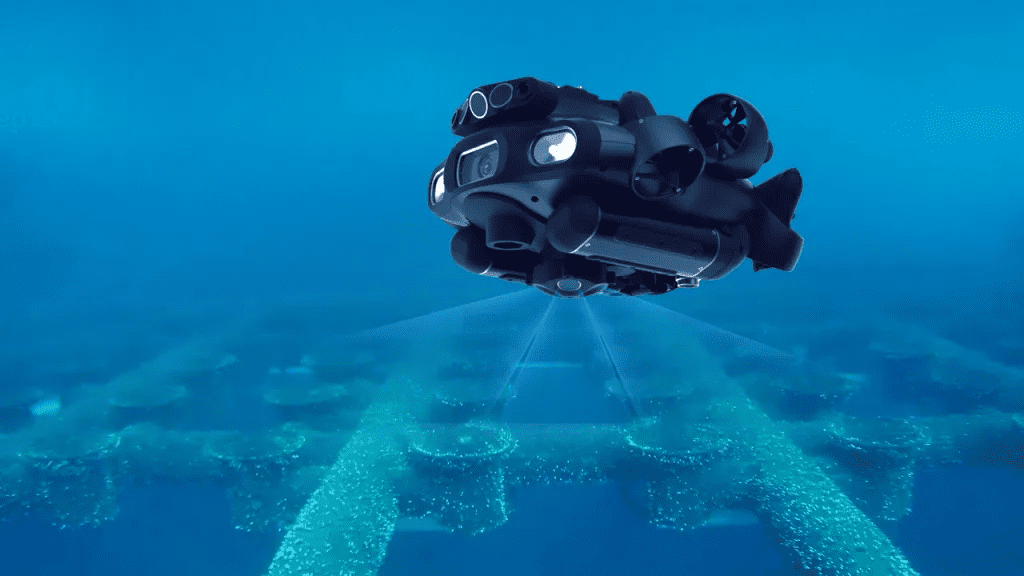
Oil and gas platforms present some of the most structurally complex inspection environments in offshore energy. Jacket frames, risers, mooring chains, and ballast compartments all require periodic assessment, yet the density of structural members and strong currents around these assets make thorough inspection genuinely difficult with conventional tools.
The E-Master’s Station Lock Hovering capability, powered by the Q-DVL sensor, holds the ROV in a fixed position relative to a structure regardless of current conditions, making inspection passes consistent and repeatable.
Smart Collision Avoidance automatically prevents contact between the robot and structural members, protecting both the asset and the vehicle when navigating the tightly packed geometry common on jacket-type foundations.
The hot-swappable dual battery system ensures power depletion never interrupts a dive, keeping the ROV on task during long inspection shifts without the time cost of a full restart.
Mapping and Monitoring Subsea Pipelines and Power Cables
Where offshore wind and oil platforms demand close-range structural scrutiny, subsea pipelines and power cables present a different challenge. These assets stretch across vast sections of seabed and are vulnerable to scour, span conditions, and external impact damage that can develop gradually and go undetected until a failure occurs.
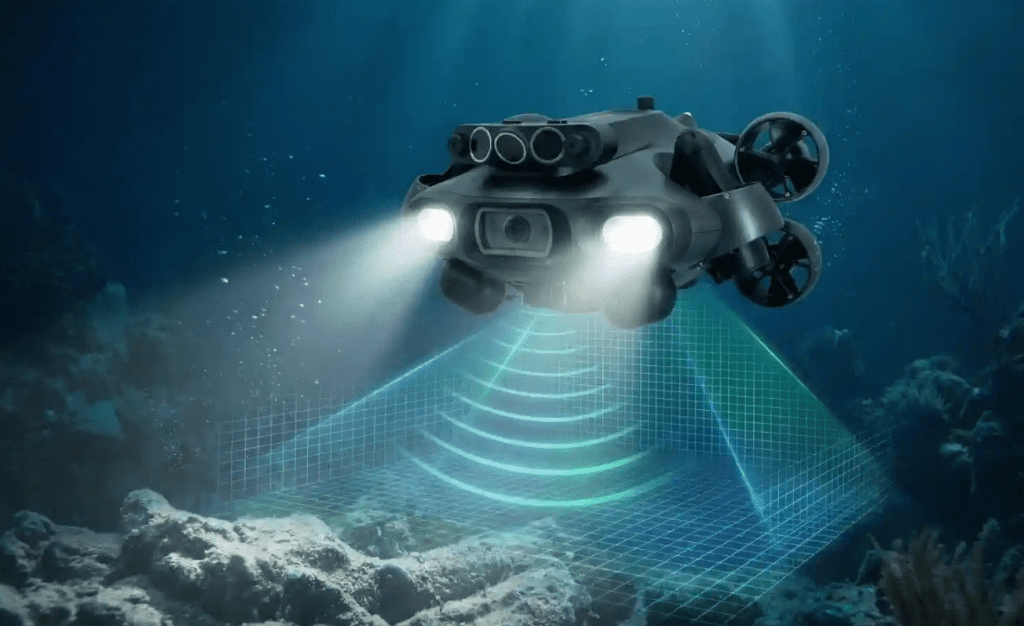
The U-INS Plus autonomous navigation system handles adaptive path planning independently using deep learning and real-time sensor data, freeing the operator to focus on monitoring the data feed rather than managing flight controls.
The QY-BT Bathymetric Tool combines the integrated echosounder and Q-DVL to generate customizable 2D and 3D seabed maps that clearly identify scour zones, exposed cable sections, and changes in elevation signaling developing risk. Reports can be exported in a single click, keeping the gap between data collection and engineering review as short as possible.
Smarter Inspections, Lower Risk, Better Data
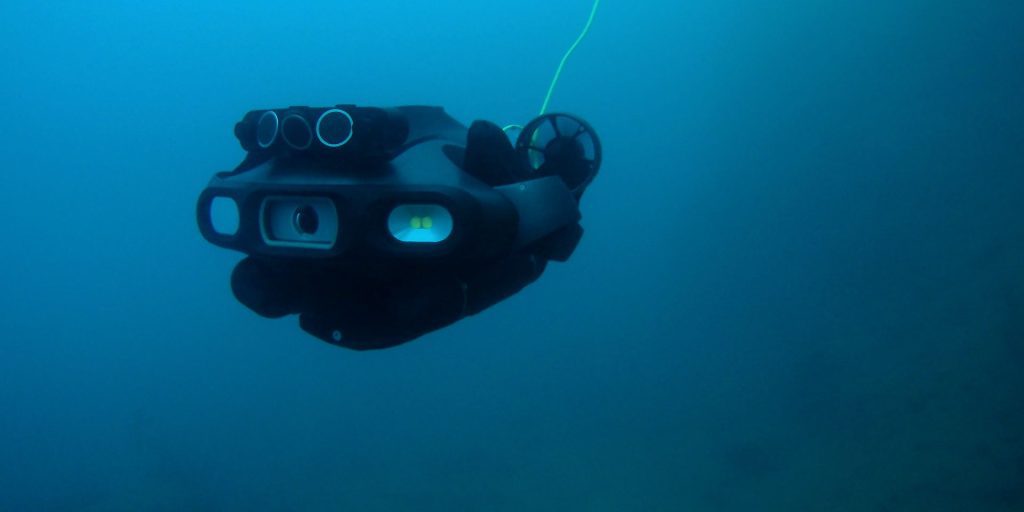
Across all three environments, the FIFISH E-Master raises the baseline of what an inspection can deliver in terms of data quality, operational continuity, and team safety.
Its compact form factor reduces vessel time and mobilization costs. The modular build lets field teams troubleshoot on site without workshop support. AI-powered tools replace subjective observations with quantifiable, repeatable data that holds up under engineering scrutiny and regulatory review.
For offshore energy operators facing tighter budgets and growing asset portfolios, the E-Master is a practical and proven answer.
Ready to bring smarter subsea inspection to your next offshore project? Dynatech Innovations is an authorized provider of the FIFISH E-Master Series. Reach out at dynatech.ae/contact or browse the full lineup at dynatech.ae.